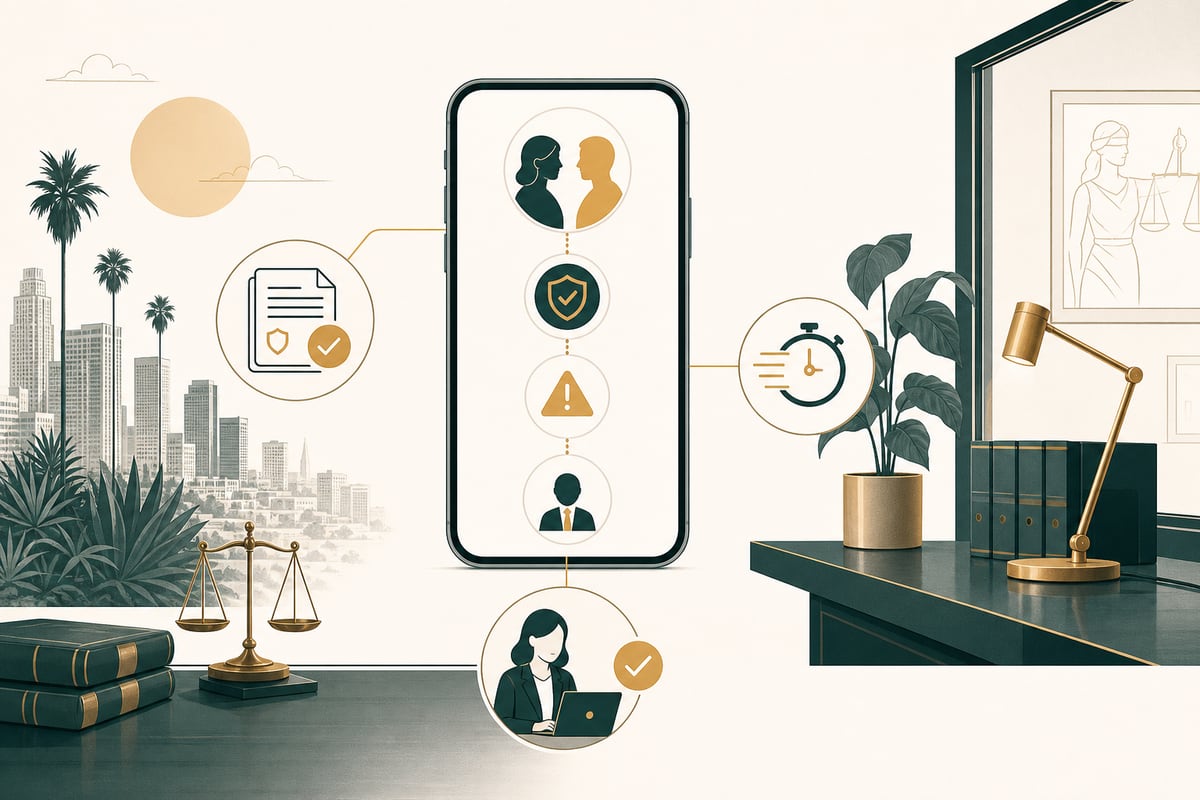
An after-hours AI line is safest and most useful when it does one job well: capture bilingual intake, set expectations, and hand the matter to your team for review. For Los Angeles immigration and personal-injury firms, the right boundaries protect client trust, reduce confusion, and help your office avoid sounding like the system is giving legal advice.
Why boundaries matter more after hours
After-hours callers are often stressed, in pain, worried about deadlines, or calling for a family member. In immigration, a caller may be dealing with detention concerns, notices, or fear about status. In personal injury, the caller may be hurt, shaken up after a crash, or unsure whether to go to the doctor first.
That is exactly why the phone experience needs structure.
If your line sounds too open-ended, callers may start asking for legal strategy, case valuation, or instructions that should come from a lawyer or trained staff member. If it sounds too robotic or evasive, they may hang up and call the next firm. A well-designed after-hours intake line sits in the middle: warm, bilingual, clear, and limited.
For most firms, that means the line should do four things:
- identify the caller and basic matter type
- collect contact details and a short summary
- screen for urgency using preapproved questions
- explain when and how the firm will follow up
That is a much safer role than trying to answer legal questions at night.
The simplest policy: intake only, not advice
For LA immigration and PI firms, the cleanest internal rule is also the easiest to explain to callers: the after-hours AI line is for intake only.
That means it can:
- greet callers in English or Spanish
- disclose that the call may be recorded in California
- gather names, phone numbers, and preferred language
- ask the type of matter
- collect a short incident or situation summary
- ask limited urgency-screening questions approved by the firm
- note the best callback time
- route emergency situations to 911 when appropriate
- promise staff follow-up during business hours
And it should not:
- tell callers whether they have a good case
- estimate settlement value
- interpret immigration eligibility
- tell someone what forms to file
- advise whether to sign documents
- tell an injury caller whether to accept an insurance offer
- predict timelines or outcomes
- create the impression an attorney has reviewed the facts
This boundary is good for compliance, but it is also good for trust. Many callers do not expect full legal analysis at 10:30 PM. They do expect a live, respectful intake experience that does not lose their information.
What this looks like in immigration intake
Immigration calls often have a high emotional temperature. Some are routine consultations; others feel urgent to the caller even when they are not true emergencies. That makes wording especially important.
A safe after-hours immigration flow might capture:
- caller name and callback number
- whether the caller prefers English or Spanish
- whether they are calling for themselves or someone else
- broad matter category, such as family petition, removal defense, work permit question, citizenship, asylum, or another issue
- whether there is an upcoming hearing, appointment, or deadline
- the date of any known notice or appointment
- a brief summary in the caller's own words
What it should avoid is moving from intake into analysis. For example, the system should not tell a caller whether they qualify for relief, whether a missed appointment can be fixed, or what the next legal step should be. It can acknowledge urgency and explain that the firm will review the intake.
That distinction matters even more in Spanish. A bilingual line should not just translate words. It should communicate the same limit clearly and respectfully in both languages, without sounding dismissive.
What this looks like in personal-injury intake
PI after-hours calls often come in when the person is still dealing with the collision, pain, towing, insurance calls, or family logistics. The goal is to collect the facts your intake team actually needs next morning without pushing the system into advice.
A safe PI intake flow might ask:
- caller name and callback number
- language preference
- date and general location of the incident
- broad accident type, such as auto, pedestrian, rideshare, slip and fall, or workplace-related
- whether the caller has already received medical attention
- whether there is an active safety emergency
- whether insurance has contacted them
- a short description of what happened
It should not advise on fault, claim value, medical treatment choices, recorded statements, or whether the case will be accepted.
If there appears to be an immediate emergency, the line should direct the caller to emergency services. TelAI's role is intake only, not legal or medical advice.
The trust piece: clear disclosures beat vague promises
A lot of firms worry that callers will distrust an AI line. In practice, confusion is usually the bigger problem than the technology itself. People are more comfortable when the system is direct about what it is doing.
A stronger approach is to disclose early:
- this is the firm's after-hours intake line
- the line can help in English or Spanish
- the call may be recorded, which matters in California's two-party-consent environment
- the line collects information for staff follow-up
- it does not provide legal advice
That is more reassuring than pretending the system is something it is not.
It also helps reduce a common after-hours failure mode: the caller thinks they "spoke to the firm" and assumes advice was already given or an attorney-client relationship was created. Your script and workflow should avoid that misunderstanding.
The handoff matters as much as the call
A safe after-hours system is not just a phone script. It is a handoff process.
If the intake is captured well but sits untouched until late afternoon the next day, the firm still loses momentum. For immigration and PI offices, speed and continuity matter. The caller should feel that the after-hours contact actually moved them into the firm's intake process.
A practical handoff policy usually includes:
- immediate delivery of the intake summary to the right team member
- clear tags for language preference and matter type
- visible flags for time-sensitive issues
- next-business-day callback targets
- internal review by staff before any substantive guidance is given
This is where many firms can improve without changing the daytime front desk at all. The after-hours line does not need to replace your receptionist. It needs to preserve opportunities until your team is back.
A good boundary is also a marketing advantage
Trust and compliance are not separate from marketing for law firms. They are part of the product.
For immigration and PI firms in Los Angeles, many callers are comparing firms quickly, often at night, often on mobile, and often in Spanish. A phone experience that is bilingual, respectful, and clearly bounded can make your office feel more organized and more credible.
That is especially true if your line:
- answers after hours instead of dropping to voicemail
- lets the caller speak naturally in English or Spanish
- sounds calm and consistent
- does not overpromise
- clearly explains what happens next
In other words, professionalism is not just about sounding polished. It is about reducing uncertainty.
Questions to settle internally before you launch
Before turning on an after-hours AI intake line, firm leadership should answer a few operational questions:
1. What matter types should the line accept?
Some firms want all immigration and PI inquiries captured. Others want to exclude certain categories and route only specific case types.
2. What counts as urgent?
Your team should define what the system may flag for faster review, while still avoiding legal advice.
3. What exact disclaimer language will be used?
This should cover after-hours status, recording disclosure, and the fact that the line is intake only.
4. Who receives the intake, and how fast do they respond?
The answer should be operational, not aspirational.
5. How will Spanish-language calls be reviewed?
A bilingual line is only useful if your follow-up process respects the caller's language preference too.
Where TelAI fits
TelAI is built for this narrow job: bilingual phone intake for law firms and professional offices, especially after hours. It is not a legal advisor, and it is not meant to replace attorney judgment. It helps your office answer calls in English and Spanish, disclose recording, collect the right intake information, and tee up a cleaner handoff to staff.
For LA immigration and PI firms, that focused scope is the point. The safer the boundary, the easier it is to deploy, supervise, and trust.
If you want to hear how a bilingual after-hours intake flow sounds in practice, call the live demo at (213) 752-9794. If you are ready to set up your line, visit /order.
Frequently asked questions
Can an after-hours AI line answer legal questions?
No. The safer approach is intake only. It can collect information and route the matter for attorney or staff follow-up.
Can it handle both English and Spanish on the same line?
Yes. For many Los Angeles firms, one bilingual line is simpler and more natural than splitting callers into separate systems.
Does the line need to disclose recording in California?
Yes, your after-hours workflow should include clear disclosure because California is a two-party-consent state.
Can it help with urgent situations?
It can screen for urgency using firm-approved questions and direct true emergencies to 911, but it should not give legal or medical advice.
Will it replace my daytime receptionist or intake staff?
Not necessarily. Many firms use it as an after-hours layer that captures opportunities and hands them to the daytime team for follow-up.