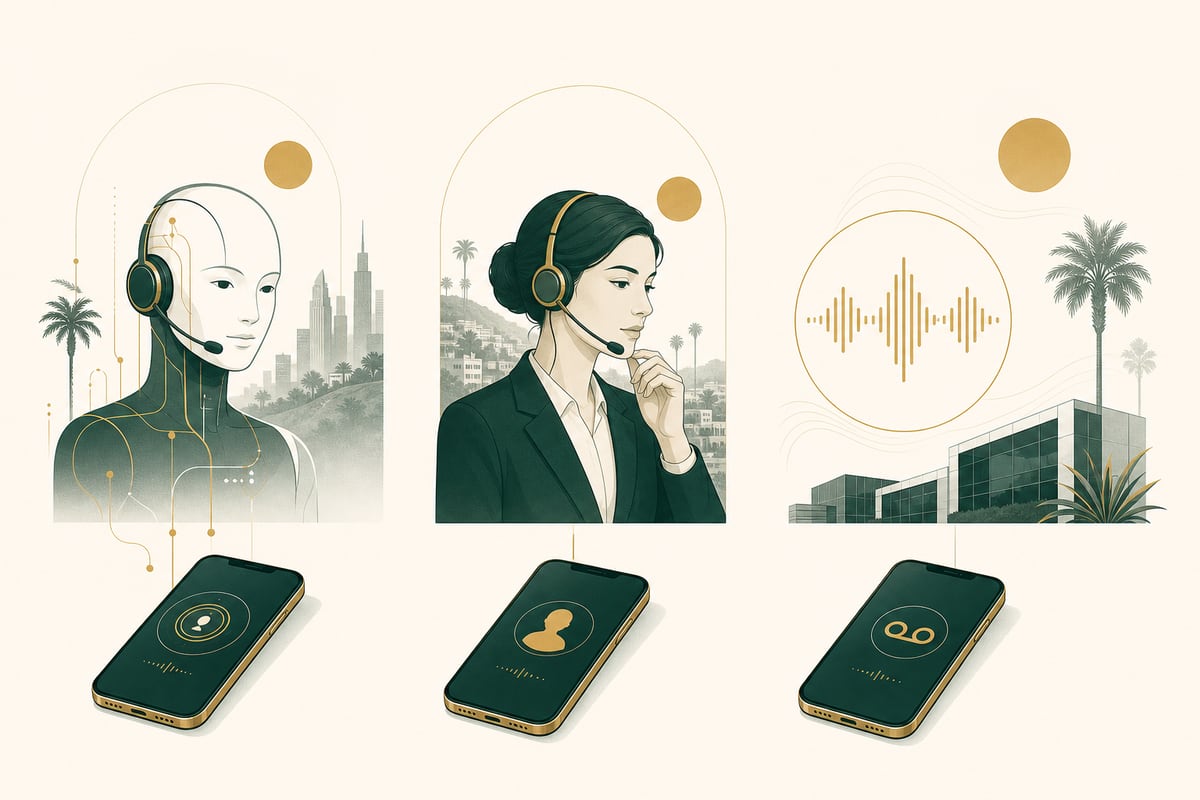
An AI receptionist, a human answering service, and voicemail all help you avoid missed calls, but they are not equal. If your office needs fast, bilingual, 24/7 intake with consistent call handling, an AI receptionist is often the strongest fit; if you need human judgment for unusual situations, a live answering service may be better; and if budget is the only concern, voicemail is the simplest but weakest option.
Why this comparison matters
When a potential client calls, the first minute matters. In a law firm or professional office, callers may be anxious, in a hurry, or comparing multiple providers at once. If nobody answers, many people will hang up and call the next number.
That is why the real question is not just AI receptionist vs answering service. It is:
- How quickly is the call answered?
- Can the caller speak English or Spanish naturally?
- Is the information captured correctly?
- Can the office follow up quickly?
- Does the system stay consistent after hours, on weekends, and during busy periods?
For Los Angeles offices in particular, bilingual call handling is not a nice extra. It is often essential.
What each option actually is
Before comparing them, it helps to define the three choices clearly.
AI receptionist
An AI receptionist answers inbound calls automatically, speaks with callers, asks intake questions, captures details, and routes or logs the conversation based on your rules. A good system can work 24/7, follow the same script every time, and handle English and Spanish without needing to "switch agents."
At TelAI, this means intake-only call handling for law firms and professional offices. The agent does not give legal or medical advice. It gathers information, explains next steps, and helps your team respond faster.
If calls may be recorded, California's two-party consent rules matter. That is why recording disclosure should be built into the call flow.
Human answering service
A human answering service uses live agents to answer calls on your behalf, usually from a centralized call center. They may take messages, collect basic intake information, transfer urgent calls, or follow a script provided by your office.
The main benefit is human flexibility. A person can sometimes read emotion, calm down a frustrated caller, or handle an unusual request better than automation.
Voicemail
Voicemail is the simplest option. If nobody answers, the caller hears a greeting and leaves a message.
It is inexpensive and easy to set up, but it puts almost all the work on the caller. Many people do not leave detailed messages, and many never leave one at all.
AI receptionist vs answering service vs voicemail: side-by-side
Here is the honest comparison.
1. Speed of answer
AI receptionist: Usually answers immediately, including after hours and during call spikes.
Human answering service: Usually fast, but callers may still wait in queue during busy times.
Voicemail: No live answer at all.
If your main goal is reducing abandoned calls, AI has a clear advantage over voicemail and often over live services during volume spikes.
2. Consistency
AI receptionist: Very consistent. It follows the same intake flow every time unless you change it.
Human answering service: Can be good, but consistency varies by agent, training, fatigue, and turnover.
Voicemail: Consistent only in the sense that everyone gets the same greeting, but the caller controls how much information is actually left.
For offices that want standard intake questions asked every time, AI is often easier to manage.
3. Bilingual handling
AI receptionist: Strong option if bilingual support is built in from the start. English and Spanish can be offered seamlessly, 24/7.
Human answering service: Some services offer bilingual agents, but availability, quality, and consistency can vary by shift.
Voicemail: You can record a bilingual greeting, but there is no actual bilingual conversation.
For Los Angeles firms, this category matters more than many vendors admit.
4. Cost structure
AI receptionist: Often more cost-efficient for repetitive intake-heavy calls, especially after hours or at scale.
Human answering service: Usually costs more because humans are staffing the phones. Rates may rise with call volume, minutes, after-hours coverage, or bilingual needs.
Voicemail: Cheapest upfront.
That said, the cheapest option is not always the least expensive in practice. A missed qualified lead can cost more than a monthly service fee.
Where AI receptionist performs best
An AI receptionist is often the best fit when your office has:
- Frequent missed calls during business hours
- After-hours or weekend inquiries
- Repetitive intake questions
- English- and Spanish-speaking callers
- A need for immediate response without adding staff
- A desire for standardized intake notes
For example, a law office might want every new caller asked for:
- Name and callback number
- Opposing party check information, if appropriate to your workflow
- Case type
- Brief summary of the issue
- Best time to call back
- Preferred language
AI is especially useful when these questions are similar across most inbound inquiries.
Where human answering services still win
An honest comparison should say this clearly: live human services still have advantages.
A human answering service may be better when:
- Calls are highly emotional and unpredictable
- You need nuanced judgment in unusual situations
- Your callers are often elderly or uncomfortable with automation
- Your intake process changes constantly and informally
- You want a person who can improvise beyond a script
A skilled live agent can sometimes de-escalate a tense conversation better than technology. Not every office wants automation as the first line for every call, and that is a reasonable decision.
Where voicemail still makes sense
Voicemail is not ideal for lead capture, but it still has uses.
It may be enough if:
- Your office gets very few new inbound calls
- Most callers are existing clients who already know your team
- You only need a backup after hours
- Budget is extremely tight
Even then, voicemail works best as a fallback, not a growth strategy.
Common weaknesses of each option
AI receptionist limitations
- It should not give legal or medical advice
- Some callers strongly prefer a human
- Poorly configured AI can sound robotic or miss edge cases
- Complex emergencies still need clear escalation rules
This is why intake-only design matters. A responsible AI receptionist should know its limits, collect information, disclose recording when required, and route urgent matters according to your rules.
Human answering service limitations
- Higher ongoing cost
- Inconsistent note quality
- Variable bilingual coverage
- Hold times during peak periods
- Training gaps if your practice area is specialized
Voicemail limitations
- High caller drop-off
- Incomplete messages
- Delayed response
- No real intake structure
- No interactive bilingual support
How to choose the right option for your office
Ask these questions:
Do you need true 24/7 coverage?
If yes, AI or a live answering service is better than voicemail.
Is Spanish-language intake important?
If yes, verify whether bilingual support is native and always available, not just offered "when possible."
Are your calls mostly structured intake?
If yes, AI is often a strong fit.
Are your calls emotionally sensitive or highly variable?
If yes, a human service may deserve serious consideration.
Is your current problem missed calls or poor message quality?
If yes, voicemail alone probably will not solve it.
A practical recommendation for Los Angeles law firms
For many Los Angeles law firms and professional offices, the most practical setup is:
- An AI receptionist as the front line for 24/7 bilingual intake
- Clear escalation paths for urgent or special situations
- Human follow-up from your office during business hours
That approach gives you speed, consistency, and bilingual coverage without pretending that AI should replace legal judgment or client advice. It should not.
If your office handles a large share of highly emotional or unusual calls, a human answering service may still be the better primary layer. But if your biggest pain point is missed calls, inconsistent intake, or lack of Spanish-language coverage after hours, AI usually solves the more urgent problem.
The bottom line
If you are comparing AI receptionist vs answering service, the honest answer is that AI is usually better for fast, scalable, bilingual intake, while human services are better for nuance and emotional complexity. Voicemail is best treated as a minimal backup, not a serious intake solution.
For firms that want every call answered, every lead captured more consistently, and every caller offered English or Spanish, an intake-focused AI receptionist is often the strongest middle ground between cost, availability, and service quality.
To hear how a bilingual intake-only AI receptionist sounds in practice, call the live demo at (213) 752-9794. If you are ready to set up service for your office, visit /order.
Frequently asked questions
Is an AI receptionist the same as a chatbot for phone calls?
Not exactly. A phone AI receptionist answers calls, speaks with callers, gathers intake information, and follows call-routing rules. It is designed for voice conversations rather than website chat.
Can an AI receptionist give legal advice?
No. A properly designed system should be intake-only. It can collect information, explain next steps, and route messages, but it should not provide legal or medical advice.
Is voicemail ever enough for a law firm?
Sometimes as a backup, yes. But if your firm depends on new inbound matters, voicemail alone usually captures less information and creates more caller drop-off than a live-answer option.
Are recorded calls allowed in California?
California has two-party consent rules, so recording disclosure matters. Your call flow should clearly notify callers if calls may be recorded.
How can I hear a bilingual AI receptionist before signing up?
You can call the live demo at (213) 752-9794 to hear how bilingual intake works, or visit /order to get started.