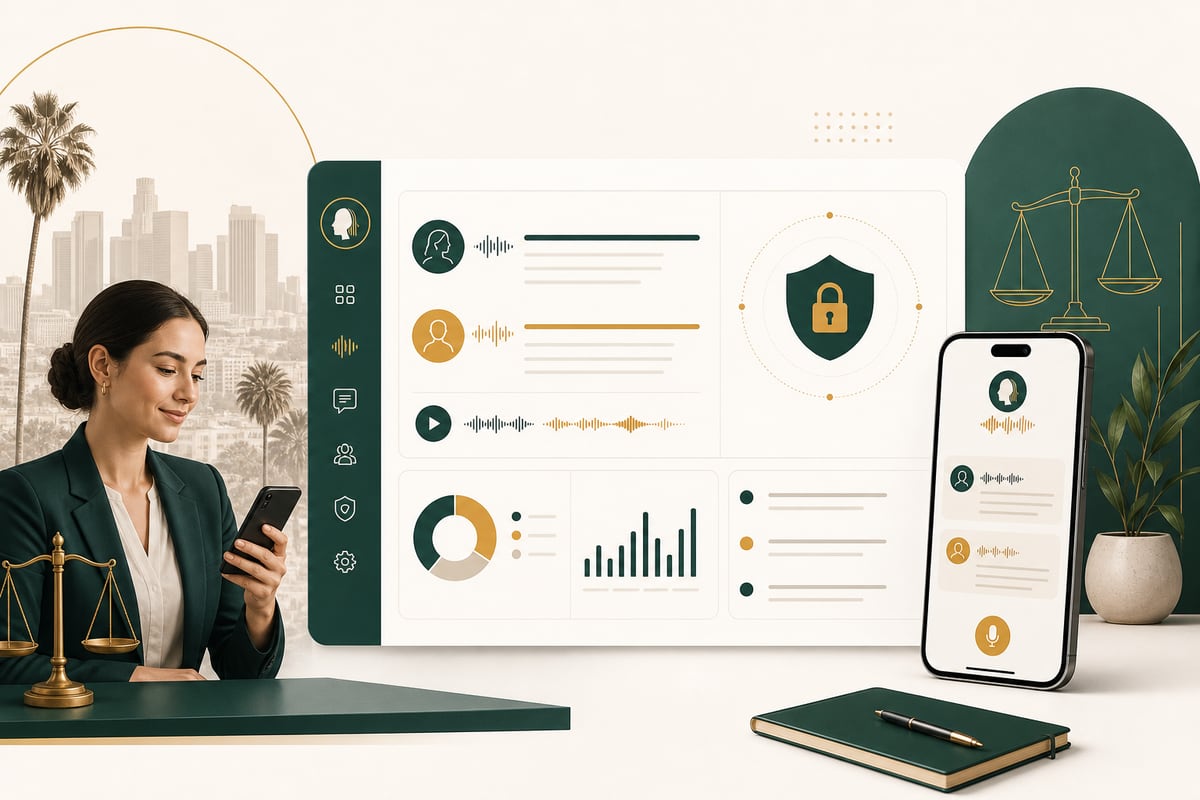
An AI receptionist should handle client call data with clear disclosure, limited collection, controlled access, and defined retention rules. If you are evaluating AI receptionist data privacy, the key questions are simple: what gets recorded, who can see it, where it is stored, and when it is deleted.
Why call data privacy matters for law firms and professional offices
When a caller reaches your office, they often share sensitive details before they ever speak with a staff member. That is especially true for law firms, medical-adjacent offices, and other professional practices where the first call may include names, phone numbers, incident dates, opposing parties, or urgent personal concerns.
An AI phone receptionist can make intake faster and more consistent, but it should not create confusion about what happens to that information. The right system should be designed around a simple principle: collect what is needed for intake, route it to the right person, and avoid unnecessary exposure.
For Los Angeles firms, another factor matters: many callers prefer Spanish. A bilingual English/Spanish intake experience helps reduce misunderstandings and avoids pushing callers to leave incomplete details because of a language barrier.
What an AI receptionist usually captures
Most AI reception systems can capture several types of call data during intake:
- Caller name
- Phone number
- Preferred language
- Reason for calling
- Basic facts relevant to intake
- Date and time of the call
- Call recording, if enabled
- Transcript of the conversation
- AI-generated summary or intake notes
- Call outcome, such as booked callback or transferred message
That does not mean every office should collect all of it.
A privacy-conscious setup should ask: what does your staff actually need to follow up? If a field is not useful for intake, there should be a good reason to capture it.
At TelAI, the focus is intake only. The agent answers calls, gathers basic intake details, and routes the information to your team. It does not provide legal advice, medical advice, or case evaluations.
Recordings, transcripts, and summaries are not the same thing
Many office managers use these terms interchangeably, but they are different:
Call recordings
A recording is the audio file of the conversation. This is often the most sensitive version of the interaction because it captures the full exchange, tone, and any extra details the caller volunteers.
Transcripts
A transcript is the text version of the call. It can be easier to search and review than audio, but it may still contain sensitive information if the caller shared it.
AI summaries or intake notes
A summary is a shorter version of the call generated for staff review. This is often the most practical record for intake because it helps your team quickly understand who called and why.
From a privacy perspective, firms should decide whether they truly need all three. In some workflows, a concise summary may be enough for routine intake, while recordings or full transcripts are kept only when necessary.
California recording disclosure matters
California is generally a two-party-consent state for call recording. That means offices should not treat recording as a hidden feature.
If calls are recorded, that should be disclosed clearly to the caller. A compliant intake flow should make that disclosure in a straightforward way at the beginning of the call, including in Spanish when needed for Spanish-speaking callers.
Just as important, disclosure should match reality. If your system says calls may be recorded, your staff should know when recording is actually turned on, where those recordings go, and who can access them.
Where client call data should live
When assessing AI receptionist data privacy, ask where each type of data is stored:
- Audio recordings
- Transcripts
- Summaries
- Contact details
- Call logs
- Integrations with CRM, case intake, or scheduling tools
The vendor should be able to explain this in plain English. If the answer is vague, overly technical, or avoids the question, that is a warning sign.
For many offices, the practical concern is not just storage location, but storage sprawl. Data may end up in multiple places at once: the phone platform, the AI system, an email inbox, a CRM, a case management tool, and internal team chats. The more places the same intake data appears, the harder it becomes to manage access and retention.
A cleaner process is usually safer: collect intake, deliver it to the designated destination, and avoid unnecessary duplication.
Who should have access to transcripts and recordings
A good AI receptionist workflow should follow least-access principles. In practical terms, that means only the people who need call data for intake, review, or follow-up should have access.
Questions worth asking include:
- Which staff roles can listen to recordings?
- Which staff roles can view transcripts?
- Who can export call data?
- Are permissions separated by office, team, or practice area?
- Is access logged or reviewable?
Even in small firms, it is wise to avoid broad default access. Sensitive call data should not be casually available to everyone just because it is convenient.
How long should call data be retained?
There is no one-size-fits-all retention period for every office. The right answer depends on your intake workflow, compliance obligations, and internal policies.
What matters most is that your retention policy is intentional.
You should be able to answer:
- How long are recordings kept?
- How long are transcripts kept?
- How long are summaries kept?
- Can data be deleted earlier?
- What happens to data when a lead does not become a client?
- Are backups also subject to deletion timelines?
Many businesses keep data longer than necessary simply because no one set a policy. That increases exposure without adding much operational value.
A better approach is to define retention by use case. For example, your team may want intake summaries available for follow-up, while full recordings are retained for a shorter period or disabled unless there is a real need.
What law firms should look for in a privacy-conscious AI receptionist
Not every AI phone system is built for professional offices. If your callers may discuss sensitive matters, look for these qualities:
Intake-only scope
The system should focus on answering, qualifying, and routing calls, not giving legal analysis or advice.
Bilingual capability
English/Spanish support should be built in, not treated as an afterthought. Privacy disclosures and intake questions should be understandable in the caller's language.
Clear recording disclosure
If calls are recorded, the system should disclose that clearly and consistently.
Configurable retention
You should know how long data is kept and whether settings can be adjusted to fit your office policy.
Limited data collection
The receptionist should gather what your office needs for intake and avoid unnecessary questioning.
Controlled access
Your staff should have role-appropriate access to recordings, transcripts, and summaries.
Plain-language answers
A trustworthy provider should be able to explain privacy practices without hiding behind buzzwords.
Common mistakes to avoid
Offices shopping for AI receptionist tools often focus on call handling speed and forget the downstream privacy issues. Common mistakes include:
- Turning on recording without a clear disclosure process
- Keeping recordings and transcripts indefinitely by default
- Giving too many team members access
- Letting intake data flow into too many systems
- Using a system that tries to answer legal or medical questions
- Overlooking Spanish-language disclosures and intake quality
These are fixable problems, but they are easier to prevent at setup than to clean up later.
How TelAI approaches client call data
TelAI is a done-for-you bilingual English/Spanish AI phone receptionist for Los Angeles law firms and professional offices. The role is narrow by design: answer calls, collect intake information, and pass it to your team.
That means:
- The agent is intake-only
- It does not give legal advice
- It does not give medical advice
- Recording disclosure is addressed for California call flows when recording is used
- Bilingual service is core, so English- and Spanish-speaking callers can complete intake more clearly
As with any vendor handling client communications, firms should review the exact workflow for recordings, transcripts, summaries, access, and retention so it matches office policy and compliance needs.
The bottom line
AI receptionist data privacy is not just about whether a system is "secure." It is about whether your office understands the full lifecycle of client call information: what is collected, how it is disclosed, who sees it, where it goes, and when it is deleted.
For law firms and professional offices, the safest setup is usually a bilingual intake-only receptionist with clear recording disclosure, limited data collection, controlled access, and defined retention practices. That gives your team the speed benefits of AI without losing sight of client trust.
If you want to hear how a bilingual intake-only AI receptionist works in practice, call the TelAI live demo at (213) 752-9794 or visit /order.
Frequently asked questions
Are AI receptionist calls always recorded?
No. Recording depends on how the system is configured. If recording is enabled, California offices should make appropriate disclosure to callers.
Do I need both transcripts and recordings?
Not always. Some offices mainly need summaries or transcripts for follow-up. The right setup depends on your workflow and retention policy.
Can a bilingual AI receptionist handle Spanish intake?
Yes, if bilingual support is built into the system. For Los Angeles offices, English/Spanish intake is important for accuracy, caller comfort, and proper disclosure.
Should an AI receptionist answer legal questions from potential clients?
No. For law firms, the safer approach is an intake-only receptionist that gathers information and routes the caller to your team rather than providing legal advice.
How can I evaluate AI receptionist data privacy before signing up?
Ask what data is collected, whether calls are recorded, how disclosure works, where recordings and transcripts are stored, who has access, and how long each type of data is retained.