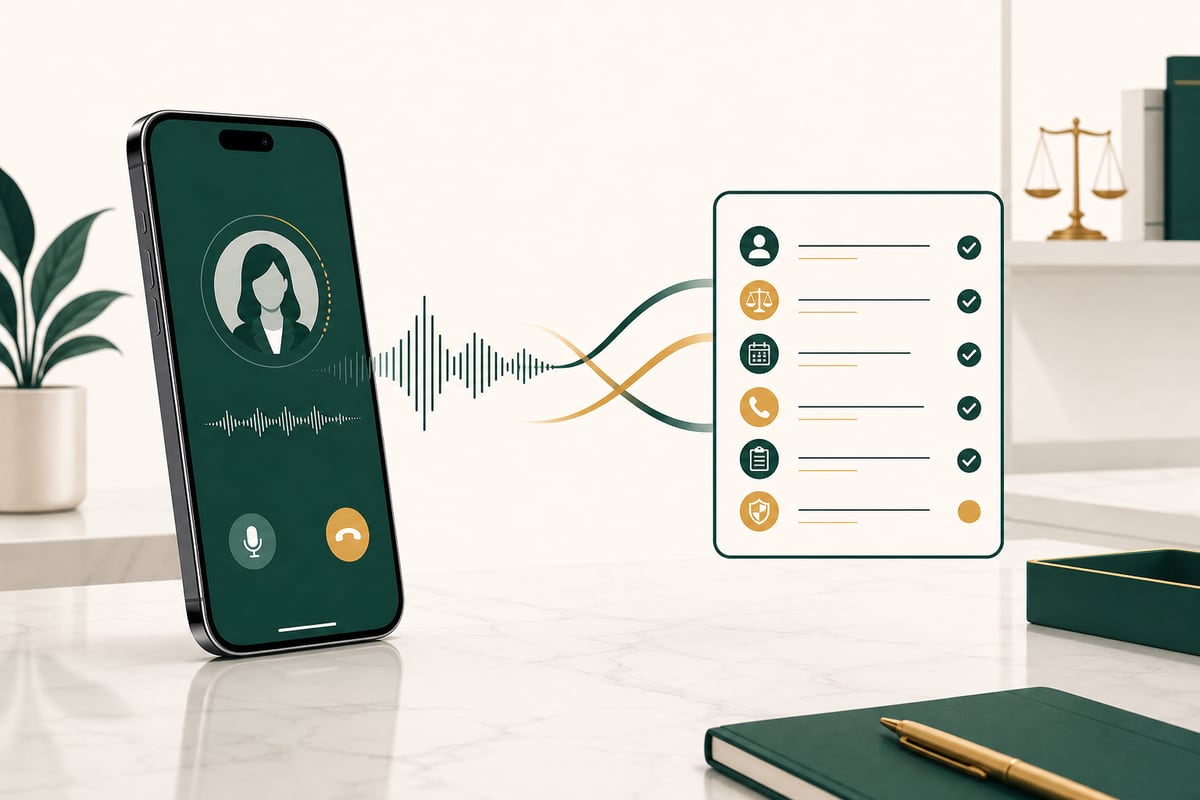
If you run a law office, the phone is still your front door — and for most of the week that door is unattended. An AI receptionist is software that answers your business line, holds a natural conversation with the caller, collects the details you need, and hands your team a clean summary — without a human picking up. This guide explains, in plain English, exactly how that works for a law practice, what it does well, and where its limits are.
What an AI receptionist actually is
Strip away the buzzwords and it's three pieces working together:
- A phone number (your existing line, forwarded, or a new local one).
- A conversational AI voice that listens and talks in real time — not a "press 1 for billing" menu, but something close to a normal conversation.
- A delivery step that turns the call into a written, structured message in your inbox.
For a law office, the job is narrow and important: greet every caller professionally, answer basic questions about the firm, take a proper intake when someone has a new matter, and make sure nothing is lost when the office is closed or everyone is on another line.
How a call works, step by step
Here is what actually happens when someone calls a TelAI line:
1. It answers on the first or second ring — every time. No hold music, no voicemail. The greeting also handles a legal requirement: in California (a two-party-consent state) the caller is told the call may be recorded and transcribed, before anything substantive is said.
2. It understands the caller — in English or Spanish. This is the part that matters most in Los Angeles. A caller can start in English and finish in Spanish mid-sentence, and the agent follows them. No separate line, no "para español, oprima dos."
3. It takes a structured intake. Instead of a vague message, it collects the specific fields a firm needs: caller name, callback number, the nature of the matter, urgency, and preferred callback language. For an immigration or personal-injury practice, those few fields are the difference between a returnable lead and a dead voicemail.
4. It delivers the lead in minutes. Before the caller has hung up, a clean summary lands in your email — often with a full transcript attached. Your team wakes up (or comes back from court) to a tidy list of who called and what they needed.
5. It escalates when it should. If a caller describes an emergency, the agent directs them to call 911. If a matter is urgent, the firm can be alerted immediately rather than waiting for the morning.
What it does not do (and shouldn't)
A good legal AI receptionist is defined as much by its restraint as its ability. It is built to take messages, not to practice law. It will not — and cannot be talked into — giving legal advice, evaluating a case, quoting an outcome, or promising anything that creates an attorney-client relationship. Asked a substantive legal question, the right behavior is a polite "I can't advise on that, but I'll have an attorney call you back — what's the best number?"
If a system happily answers legal questions, that's a liability for the firm, not a feature. The receptionist's job is to capture the human and hand them to a human.
What a law office actually gets out of it
The value isn't "robot replaces staff." It's coverage of the hours and overflow your staff can't reach:
- After-hours and weekends, when many clients — especially those working daytime jobs — actually call.
- Lunch and overflow, when your one receptionist is already on another line.
- Bilingual capture, so a Spanish-speaking caller who would never leave a voicemail becomes a logged lead instead of someone else's client.
For a practice where a single new matter can be worth thousands, recovering even one or two otherwise-lost callers a month tends to cover the cost several times over.
Questions to ask before you trust one with your line
- Does it disclose recording, the way California law requires?
- Is it genuinely bilingual mid-conversation, or is Spanish a bolt-on?
- Is it explicitly prevented from giving legal advice?
- What happens to recordings and transcripts — where are they stored, and for how long?
- Is it set up and tuned for your firm, or are you handed a blank dashboard to configure yourself?
- Is there a low-risk way to start — like after-hours only — before it touches your main line?
That last point matters. The safest way to begin is to keep your current setup and forward only the calls you'd otherwise miss.
How setup works
With a managed service like TelAI it's about a week from a kickoff call: we configure the greeting, your office facts, your intake questions, and the legal-safe boundaries; you test-call it as hard as you like; and it goes live on your line only when you say so. You can hear a working example right now on the live demo line: (213) 752-9794 — try it in Spanish, and try to get legal advice out of it.
Frequently asked questions
How does an AI receptionist work for a law office? It answers your business line with a conversational AI voice, greets the caller (disclosing call recording where the law requires it), answers basic firm questions, takes a structured intake — name, number, matter, urgency, language — and emails your team a summary within minutes, escalating emergencies to 911 and urgent matters to staff.
Can an AI receptionist give legal advice? No. A properly built one is designed never to give legal advice or create an attorney-client relationship. It takes the message and routes the caller to a qualified attorney.
Does it work in Spanish? Yes — a strong system switches between English and Spanish mid-conversation and completes the full intake in the caller's language, flagging their preferred callback language for your team.
Is recording the call legal? In two-party-consent states like California, the call must disclose recording up front. A compliant AI receptionist builds that disclosure into the greeting automatically.
Will it replace my receptionist? It's better understood as a safety net than a replacement — covering after-hours, weekends, lunch, and overflow so no caller reaches an empty line. Most firms start with after-hours only.
TelAI is a done-for-you bilingual AI receptionist for Los Angeles law firms and professional offices. Hear it answer on the live demo — (213) 752-9794 — or request a setup.