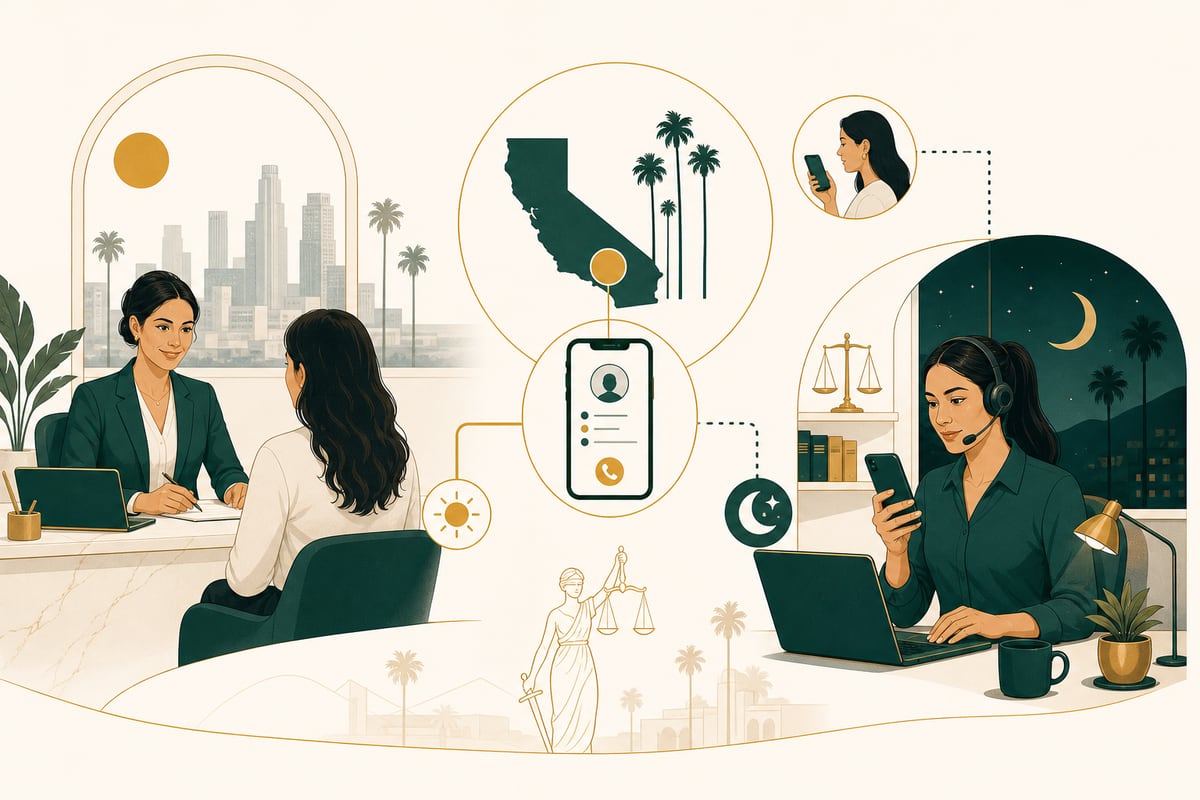
A law firm can add a bilingual after-hours intake line without replacing its daytime receptionist, and for many LA immigration and personal-injury offices, that is the lowest-friction way to improve coverage. The idea is simple: keep your current front desk workflow during business hours, and use an intake-only bilingual AI line only when your team is unavailable.
Why this setup makes sense for LA immigration and PI firms
Many firms are not looking to overhaul their phones. They want fewer missed calls at night, on weekends, during lunch breaks, or when staff are tied up. That is especially true for immigration and personal-injury practices in Los Angeles, where potential clients may call outside office hours and may prefer Spanish.
A separate after-hours line solves a narrower problem:
- answer new-client calls when the office is closed
- offer English and Spanish from the first hello
- collect basic intake details
- route urgent matters according to your instructions
- send your team a transcript or summary for follow-up
Just as important, it does not require changing the way your front desk works at 10:00 AM on a Tuesday.
For firms that are cautious about trust, compliance, or staff adoption, this matters. You can improve coverage without asking your receptionist to learn a whole new system on day one.
What “without changing your front desk” actually means
In practice, this usually means your office keeps its current daytime call handling:
- your receptionist or intake staff answer during business hours
- your main phone process stays the same
- existing extensions, transfers, and staff habits remain in place
Then, after hours, calls follow a different path:
- unanswered new-client calls forward to the intake line
- the caller hears a clear greeting in English and Spanish
- the system discloses recording if recording is enabled, consistent with California two-party-consent rules
- the caller is told they are speaking with an automated intake assistant
- the assistant gathers intake information only
- the assistant does not give legal advice, case predictions, or strategy
This split setup is attractive because it limits change. The AI is there to capture opportunities your office would otherwise miss, not to take over every interaction.
What the after-hours intake line should handle
The safest use case is narrow and specific. For immigration and PI firms, that usually means new-client intake only.
A good after-hours flow may include:
- caller name and callback number
- preferred language
- practice area needed
- a short description of the issue
- date of incident for PI, if relevant
- whether the caller already has an attorney
- whether there is an upcoming hearing, deadline, or urgent issue
- best time to call back
For personal-injury firms, the intake line can ask factual questions about the accident or injury. For immigration firms, it can ask what type of matter the caller is calling about, such as family-based, removal defense, work-related, or another general category.
But the line should stop short of legal judgment. It should not tell someone whether they have a strong claim, whether they qualify for status, what a settlement may be worth, or what form to file.
That limit is not a weakness. It is part of the trust and compliance value.
Why bilingual matters more after hours
After hours, callers have fewer chances to clarify confusion. There is no staff member nearby to jump in if the interaction breaks down. That makes bilingual handling more important, not less.
For LA firms, “bilingual” should mean more than a translated opening sentence. It should mean the caller can complete the entire intake in English or Spanish with a natural flow, including:
- greeting
- consent language
- explanation that the line is automated
- intake questions
- confirmation of contact details
- next-step expectations
This is especially relevant in immigration, where callers may be stressed, calling on behalf of family members, or uncertain about terminology. It also matters in PI, where callers may be in pain, dealing with insurance confusion, or calling from a noisy environment after an accident.
A bilingual after-hours line helps reduce the risk that a caller hangs up simply because no one could help them in their preferred language when they were finally ready to call.
Trust comes from clarity, not from pretending the AI is human
One mistake firms should avoid is trying to make the system sound like a live receptionist when it is not. A more trustworthy approach is straightforward:
- identify the system as an automated intake assistant
- state that it can collect information for the firm
- explain when the firm will follow up
- disclose recording where applicable
- avoid legal advice or promises
That kind of script often builds more confidence than a vague or overly polished one. People generally respond better when they understand what the system can and cannot do.
For law offices, clear expectations are part of good client service.
A practical routing policy for this setup
The simplest version is usually best. A law firm might use a policy like this:
During business hours
- front desk answers first
- if staff miss the call, it can roll to voicemail or, if the firm wants, to the intake line after a set number of rings
After business hours
- all new-client calls forward to the bilingual intake line
- existing-client support can go to voicemail, emergency instructions, or another firm-defined path
On weekends and holidays
- same as after-hours handling
- urgent flags generate a text or email alert to the designated staff member if the firm wants that
The key is to keep the scope narrow enough that staff trust the process.
Compliance and policy points firms should decide in advance
Before turning on any after-hours intake line, firms should set clear internal rules.
Important decisions include:
- which calls should go to the intake line
- which matters should trigger escalation alerts
- whether calls are recorded
- what recording disclosure language will be used under California rules
- how transcripts or summaries are stored
- who has access to them
- how long the firm wants to retain intake records
- whether the line handles only new leads or also current clients
For most firms in this niche, intake-only is the cleaner policy. It reduces confusion and lowers the chance that a current client tries to use the line for legal guidance that should come from the attorney or staff.
Signs this approach is a good fit
A bilingual after-hours intake line is often a strong fit if:
- your office already has a capable daytime receptionist
- you do not want to retrain your whole team yet
- you miss calls at night or on weekends
- Spanish-speaking leads are not being served consistently after hours
- you want a more professional alternative to voicemail
- you want to test AI in a limited, lower-risk role
It may be less appropriate if your firm expects the system to replace legal staff, answer substantive case questions, or manage sensitive ongoing client communications without clear guardrails.
What a successful first phase looks like
Success does not require a dramatic phone overhaul. In many firms, the first win is simply this: when someone calls after hours in English or Spanish, the firm still responds in a professional way, captures the intake, and sets up a real follow-up.
That is the point of the setup.
For immigration and PI offices, missed calls often happen at the edges of the day, not because the staff is doing a poor job, but because no front desk can be available at all times. A separate after-hours intake line addresses that gap while preserving the human daytime experience your office already trusts.
If you are AI-curious but operationally cautious, this is one of the most practical ways to start.
Frequently asked questions
Does this replace my receptionist?
No. This setup is designed to leave your daytime front desk in place and add intake-only coverage when your team is unavailable.
Can the line speak both English and Spanish fluently throughout the call?
That is the goal. For LA law firms, bilingual intake should cover the full interaction, not just the greeting.
Can it give legal advice or tell callers whether they have a case?
No. An intake-only system should collect facts and route the matter. It should not give legal or medical advice.
Do callers need to be told that the call may be recorded?
If recording is enabled, California two-party-consent rules make disclosure important. The greeting should clearly inform callers before the recorded conversation continues.
How do we try this without changing our office phones too much?
The simplest path is to keep daytime handling as is and forward after-hours new-client calls to a separate bilingual intake line.
To hear how it works live, call (213) 752-9794 or get started at /order.