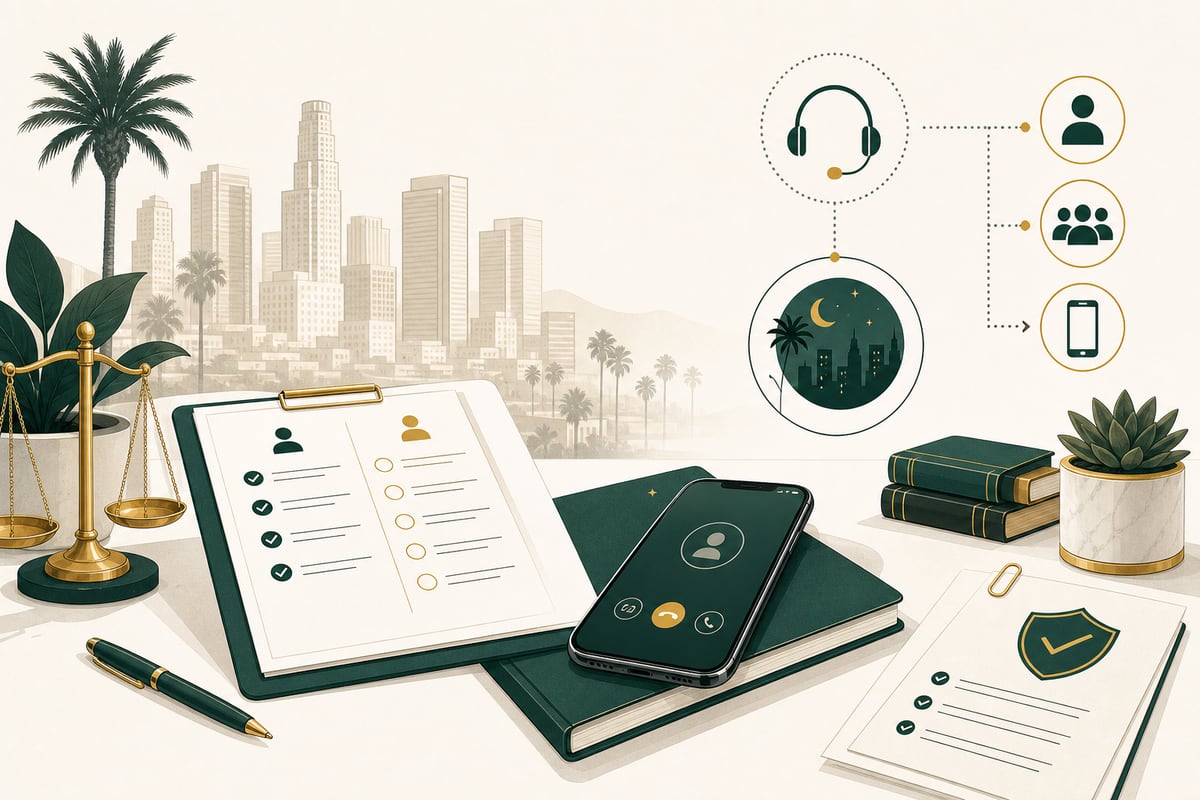
Direct answer: yes, your firm can screen urgent after-hours calls without giving legal advice—if the system is limited to intake, follows a clear escalation policy, and uses compliant disclosures in English and Spanish. For Los Angeles immigration and personal-injury firms, the goal is not to advise callers; it is to identify urgency, capture accurate facts, and route the call appropriately.
Many firms worry about the same thing: if a caller reaches out at 8:30 PM in Spanish, sounds distressed, and mentions court, detention, an accident, or an injury, how do you respond helpfully without crossing the line into legal advice? That concern is valid. A phone line should never guess, reassure beyond what it knows, or tell someone what legal action to take.
A safer after-hours approach is narrower. The line should greet the caller, disclose that calls may be recorded, explain that it is an intake line and not a lawyer, collect the basic facts, recognize certain urgency signals, and then route or escalate according to your firm's rules.
What "urgent" should mean for an after-hours intake line
In practice, urgent does not mean "solve the legal problem now." It means "this caller may need faster human review than a standard next-business-day callback."
For LA immigration and PI firms, urgency often falls into a few buckets:
- A detained or recently arrested family member in an immigration-related matter
- A caller mentioning an upcoming hearing, interview, deadline, or removal issue
- A recent accident with injuries, hospitalization, or a tow
- A caller who says evidence may disappear soon
- A caller who sounds confused about immediate safety or medical needs
The intake line can identify these issues without advising the caller on what legal rights they have or what exact next step they should take.
That distinction matters. "I can note that this may be time-sensitive and alert the firm" is intake. "You should file X tomorrow" is legal advice.
The safe job of an intake-only AI receptionist
An intake-only line has a limited role. It should:
- Answer after hours in English or Spanish
- State that it is a virtual receptionist for intake
- Disclose that calls may be recorded, consistent with California two-party consent requirements
- Collect contact information and a brief description of the issue
- Ask a short set of firm-approved screening questions
- Flag urgency based on your policy
- Route emergencies outside legal scope to 911 or appropriate emergency services
- Pass the lead to your team for follow-up
It should not:
- Evaluate the merits of a case
- Predict outcomes
- Interpret legal deadlines
- Tell the caller what forms to file or what to say to police, ICE, insurers, or the court
- Claim attorney-client representation exists
That is especially important for vulnerable callers and for Spanish-speaking callers who may assume that a fluent, confident voice is authorized to advise them. Bilingual service is valuable, but only if the boundaries are clear.
A practical after-hours screening workflow for immigration and PI firms
A good workflow is simple enough to audit and strict enough to reduce risk.
1. Start with identity and disclosure
The first moments should establish three things:
- The caller has reached your firm or your firm's intake line
- The line is virtual and for intake purposes
- The call may be recorded
That disclosure should be available in both English and Spanish, naturally spoken, and easy to understand.
2. Confirm language preference
If the caller is more comfortable in Spanish, the conversation should switch immediately. For immigration and PI practices in Los Angeles, this is not a nice extra. It is often the difference between a completed intake and a lost lead.
3. Collect the basics
Before anything else, capture:
- Full name
- Callback number
- Email, if available
- Preferred language
- Whether they are a new or existing client
This sounds basic, but many firms lose after-hours opportunities simply because a voicemail contains an incomplete number or a rushed explanation that no one can verify.
4. Ask firm-approved urgency questions
The screening questions should be short and neutral.
Examples include:
- Are you calling about immigration or an accident/injury matter?
- Is there a hearing, interview, court date, or deadline coming up soon?
- Did the accident happen today or recently?
- Is anyone currently in detention or in the hospital?
- Are you safe right now?
These questions gather facts. They do not advise.
5. Route true emergencies out of scope
If someone needs police, fire, or medical help, the line should say so directly and stop pretending this is a legal-intake issue.
For example, if the caller says someone cannot breathe, is unconscious, or is in immediate danger, the line should instruct them to call 911. That is not legal advice; it is basic emergency routing.
6. Flag and notify based on your rules
Not every urgent lead requires waking someone up. But some firms want immediate text or email alerts when a caller mentions detention, hospitalization, a same-week hearing, or a same-day collision. Others prefer a next-morning priority queue.
The point is consistency. A reliable policy is better than an improvised one.
Why bilingual urgency screening needs extra care
A direct translation of an English script is usually not enough. In high-stress moments, callers may use informal phrasing, regional vocabulary, or fragmented explanations.
For example, a Spanish-speaking caller may not use the exact legal term your staff expects. They may describe the situation indirectly: a family member was "picked up," someone is "in migration," or they have "papers for court." The line needs to handle real-world phrasing without pretending to understand more than it does.
That is why bilingual intake should focus on clarification and confirmation:
- Repeat back names, dates, and phone numbers
- Confirm whether the issue is happening now or already happened
- Ask whether the caller wants a callback in English or Spanish
- Avoid slang-heavy or robotic wording
The goal is accuracy and trust, not speed alone.
Common mistakes firms should avoid
Some after-hours setups create more risk, not less.
Mistake 1: letting the system sound like a lawyer
If the caller believes they are speaking to an attorney or getting legal analysis, expectations and risk both rise. The line should clearly identify itself as intake support.
Mistake 2: asking too much before capturing contact info
A stressed caller may hang up. Get the callback number early.
Mistake 3: treating every "urgent" call the same
A caller with a question about a future consultation is not the same as a family member reporting detention or a crash victim calling from the ER. Your workflow should reflect that.
Mistake 4: no Spanish-first path
If Spanish-speaking callers have to struggle through an English menu or wait for a callback the next day, many will move on.
Mistake 5: no written escalation policy
If your team cannot explain which calls get alerted, when, and why, you do not have a process—you have improvisation.
What a trustworthy after-hours setup should sound like
Trust comes from clarity, not hype. A good intake line sounds calm, competent, and limited.
It does not promise help it cannot deliver. It does not overstate urgency. It does not guess at legal rights.
For legal offices, especially in immigration and personal injury, the best after-hours system is often the one that does less—but does it reliably:
- answer the call,
- speak the caller's language,
- disclose recording,
- collect the facts,
- identify obvious urgency,
- and get the matter to the right human workflow.
That is the real value of an after-hours intake-only receptionist. It protects the client experience without pretending to replace legal judgment.
Where TelAI fits
TelAI is built for this narrower, safer role. We provide a bilingual English/Spanish AI phone receptionist for law firms and professional offices, with a focus on after-hours intake. The agent is intake-only. It does not give legal or medical advice. It can disclose that calls may be recorded, collect the basics, follow your firm-approved screening flow, and route urgent matters according to your policy.
For Los Angeles immigration and PI firms, that means you can extend coverage after hours without replacing your daytime front desk or turning your phone line into an unsupervised advice channel.
If you want to pressure-test your own after-hours workflow, the right question is not, "Can AI handle everything?" It is, "Can our intake line reliably identify urgency, serve Spanish-speaking callers, and stay inside clear compliance boundaries?"
That is a much better standard.
Frequently asked questions
Can an after-hours AI receptionist tell a caller whether they have a case?
No. An intake-only receptionist should not evaluate a case, predict outcomes, or give legal advice. Its role is to gather information and route the call.
Can it handle both English and Spanish callers?
Yes, if the system is designed for bilingual intake from the start. For many LA immigration and PI firms, that is essential, not optional.
What about emergency situations?
If a caller describes an immediate medical or public-safety emergency, the line should direct them to call 911. That is emergency routing, not legal advice.
Do callers need to be told the call may be recorded?
Yes. California is a two-party-consent state, so firms should use a clear recording disclosure.
How can we try this without changing our daytime reception?
A common approach is to use an intake-only line after hours and keep your daytime front desk unchanged. To hear a live demo, call (213) 752-9794 or get started at /order.