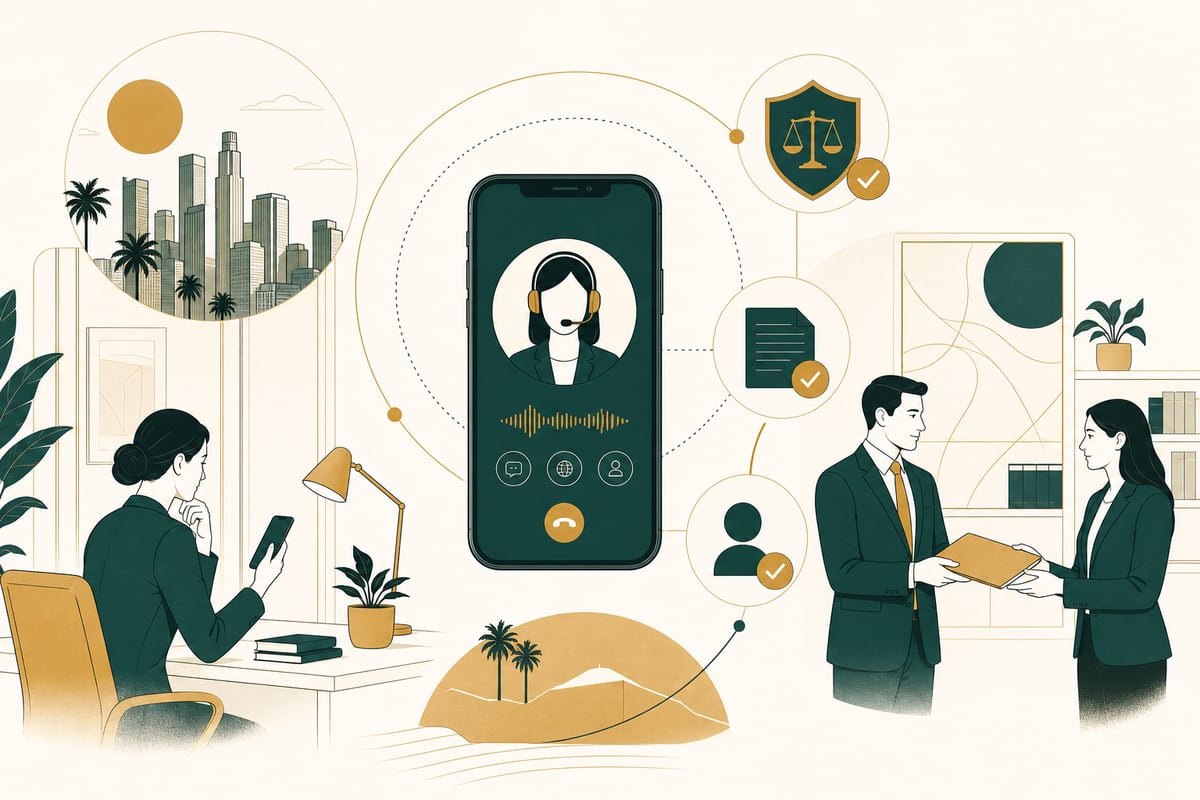
If your LA law firm wants to capture more after-hours calls without creating risk, the answer is simple: use a bilingual intake-only line with strict boundaries. The safest setup is one that gathers caller details, identifies urgency, discloses recording, and promises a human follow-up—without giving legal advice or pretending to replace your staff.
Why boundaries matter more than features
For immigration and personal-injury firms, after-hours callers are often stressed, confused, or calling at the worst moment of their day. Some want reassurance. Some want to know whether they have a case. Some mainly want to know if someone is truly listening.
That is exactly why boundaries matter.
An after-hours AI line should not try to sound like a lawyer, make judgment calls about legal merit, or answer case-specific questions. Its job is narrower and more useful: answer the phone, communicate clearly in English or Spanish, collect the right intake details, and route the matter for human review.
In practice, a firm usually gets the best result when the line is built to do four things well:
- greet callers professionally in English and Spanish
- disclose that the call may be recorded, as required by policy
- collect structured intake information
- set correct expectations for human follow-up
Everything beyond that should be treated carefully.
What a safe after-hours intake line should do
A good after-hours intake system helps your firm become easier to reach without becoming careless.
For LA immigration and PI offices, a safe intake-only line can usually handle:
- caller name and callback number
- preferred language
- basic matter type
- date, location, or timeline of the issue
- whether the caller is safe and whether the situation seems urgent
- short factual summary in the caller’s own words
- best time for your office to call back
That may sound simple, but simple is often exactly what works.
A caller who reaches a calm, bilingual line at 10:30 PM and successfully leaves a clear intake is much more likely to feel that your office is organized and responsive. That matters for both marketing and trust. It also gives your team a cleaner handoff the next morning.
For personal-injury firms, this can mean capturing the basics of an accident, injury, treatment status, and contact details. For immigration firms, it can mean identifying the broad issue—such as family-based matter, removal concern, work-related issue, or timing question—without attempting to analyze eligibility.
What it should never do
The fastest way to make an after-hours line risky is to ask it to do too much.
An intake-only system should never:
- give legal advice
- predict case value or case outcome
- interpret deadlines as legal guidance
- tell a caller they do or do not have a case
- tell an immigration caller what forms to file or what status they qualify for
- advise a PI caller on settlement, fault, or litigation strategy
- create false urgency or false reassurance
- pretend to be a human staff member if it is automated
This is not just about compliance. It is also about credibility.
Callers can forgive a system for being limited. They are much less likely to forgive a system that sounds confident while being wrong.
The best boundary: intake first, attorney judgment later
Many firms think the goal of an after-hours line is to solve the call. Usually, it is not.
The goal is to preserve the opportunity for a proper next step.
That means the line should capture enough information for your team to review the matter efficiently, while leaving legal judgment where it belongs: with licensed professionals and trained staff.
A clean after-hours process often looks like this:
- The caller reaches the firm after hours.
- The line greets them in English or Spanish.
- The system discloses recording and explains it is an intake line.
- The caller shares basic facts and contact information.
- Urgent situations are flagged based on your firm’s rules.
- The caller is told when and how a human will follow up.
- Your team reviews the intake and decides the next step.
That structure is especially helpful in immigration and PI because the facts may be emotionally charged, incomplete, or time-sensitive. A tightly scoped intake line helps you avoid overpromising while still being available.
Why bilingual boundaries are especially important in Los Angeles
In Los Angeles, bilingual support is not a bonus feature. For many firms, it is part of basic accessibility and trust.
But “bilingual” should not mean that the Spanish side is weaker, more confusing, or less careful than the English side. The same boundaries should apply in both languages.
That includes:
- the same recording disclosure
- the same intake scope
- the same no-advice rule
- the same urgency screening logic
- the same expectation-setting for callback
This matters because trust breaks quickly when callers feel that one language path is less clear than the other.
A Spanish-speaking caller who reaches your office after hours should be able to explain what happened, understand what the line can and cannot do, and know that a real person from your firm will review the intake. That is the standard.
How to decide your firm’s actual boundaries
Every office says it wants safe after-hours coverage, but the real question is operational: what exactly do you want the line to handle?
A useful way to decide is to define your boundaries in three layers.
1. Allowed intake tasks
These are the tasks the line should perform every time.
Examples:
- collect name, phone, and language preference
- ask what happened
- note whether the caller already has a lawyer
- capture timing details
- ask for best callback window
2. Sensitive but allowed screening questions
These are questions your firm may want asked carefully because they help your staff prioritize calls.
Examples:
- Is anyone in immediate danger?
- Is there an upcoming hearing, court date, or deadline?
- Did the accident happen recently?
- Has the caller received any notices from immigration authorities?
These questions can help surface urgency without crossing into advice.
3. Prohibited topics
These are the areas where the line should stop short and defer to your team.
Examples:
- “Can I win?”
- “What is my case worth?”
- “Should I sign this settlement?”
- “Can I be deported?”
- “What should I file?”
The safest response is short and honest: the line can take information and a member of the firm can follow up, but it cannot provide legal advice.
Trust comes from clarity, not from pretending to do more
Some firms worry that a limited after-hours line will feel too basic. In reality, many callers prefer clarity over improvisation.
A trustworthy line does not try to impress callers with complicated answers. It does three simpler things:
- it responds promptly
- it communicates clearly in the caller’s language
- it explains the next step without confusion
For an immigration or PI caller, that can be enough to keep them from hanging up and moving on to another firm.
It also reduces problems for your staff. When expectations are set correctly, your team spends less time undoing bad assumptions created overnight.
A note on recording disclosure and compliance
If your firm records calls, the line should clearly disclose that before the conversation continues. California is a two-party-consent state, so this is not something to treat casually.
The line should also be transparent that it is handling intake, not legal advice. That protects callers from misunderstanding and helps your firm maintain a more defensible, professional process.
TelAI is designed for intake only. It does not replace attorney judgment, and it should not be used to give legal or medical advice.
Where this fits in a real law-office workflow
For most firms, the safest use case is narrow: after-hours, overflow, weekends, and times when your in-house team cannot answer every call live.
That makes it easier to preserve your normal daytime process while reducing missed opportunities at night.
For example, an LA immigration or PI office might keep its front desk exactly as it is during business hours and use a bilingual after-hours line only when:
- the office is closed
- staff are unavailable
- call volume spikes
- Spanish-speaking callers need immediate basic intake support
This kind of setup is often easier to adopt because it does not require your firm to hand over full client communication. It simply closes the gap that voicemail leaves behind.
The practical takeaway
A bilingual after-hours line works best when it has clear limits.
If it tries to act like a lawyer, it creates risk. If it acts like a disciplined intake tool, it can help your firm capture more potential matters, serve English- and Spanish-speaking callers more consistently, and protect trust at the first point of contact.
For LA immigration and personal-injury firms, that is usually the right standard: be available, be bilingual, be clear, and leave legal judgment to the humans.
If you want to hear how a bilingual after-hours intake line sounds in practice, call the live demo at (213) 752-9794 or visit /order.
Frequently asked questions
Can an after-hours AI line answer legal questions?
No. A safe legal intake line should collect information and set expectations for follow-up, but it should not give legal advice.
Can it speak with callers in Spanish and English?
Yes. For Los Angeles law firms, bilingual support should work clearly in both languages, not just as a partial add-on.
Should the line disclose recording?
Yes. If calls are recorded, the disclosure should be made clearly. California two-party-consent rules make this important.
Can this replace my daytime receptionist or intake staff?
Usually, the safer fit is after-hours or overflow intake support. It is best used to capture information and hand off to your team.
How can I try it for my firm?
You can call the live demo at (213) 752-9794 or go to /order to see whether a bilingual after-hours intake setup fits your office.