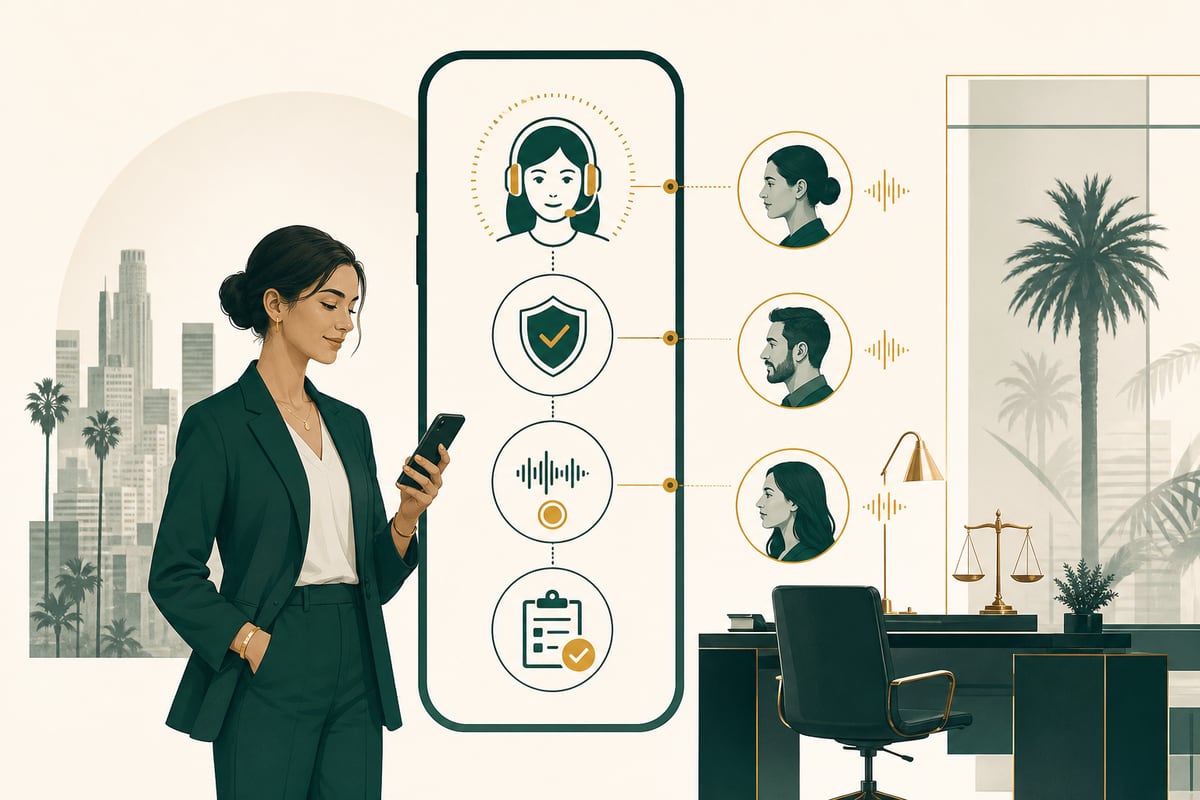
A strong bilingual after-hours greeting can keep more immigration and personal-injury callers on the line while setting clear legal and compliance boundaries from the start. For Los Angeles firms, the safest approach is a short, warm opening that identifies the firm, discloses recording, explains that the line is for intake only, and offers English or Spanish immediately.
Why the opening of the call matters so much
After-hours callers are often stressed, tired, injured, worried about status, or calling from a noisy place. Some have never contacted a lawyer before. Others are comparing multiple firms in one evening. In that moment, the first few seconds do more than greet them.
They answer basic trust questions:
- Did I reach a real law office?
- Can I speak in Spanish if I need to?
- Is this safe to continue?
- Will someone actually follow up?
- Am I being pushed into a bot conversation that goes too far?
For immigration and PI firms in Los Angeles, this matters even more because many after-hours callers are high-anxiety callers. A confusing opening can feel risky. A cold opening can feel dismissive. A long opening can cause drop-off before intake even begins.
That is why the greeting should do only a few jobs, and do them well.
What a good after-hours greeting should accomplish
A trustworthy bilingual legal-intake greeting should:
- Identify the firm clearly
- State that the line is after-hours or for intake
- Disclose recording in a California-compliant way
- Offer English and Spanish right away
- Make clear that no legal advice is being given
- Set expectations for follow-up
- Move quickly into intake questions
What it should not do:
- Sound like a fake human
- Promise representation
- Give legal or medical advice
- Invite long, unstructured storytelling before basic routing
- Sound like a generic call center script
For TelAI, this is a core design principle: the phone agent is intake-only. It gathers basic information, captures the reason for the call, handles bilingual conversation, and passes the intake to the firm for human review and follow-up.
The safest structure for the first 30 seconds
For most LA immigration and PI firms, a good structure looks like this:
1. Firm identification
The caller should immediately hear the law office name or a clear reference to the office they intended to reach.
Example:
Thank you for calling Smith & Rivera Law.
This sounds simple, but it matters. A caller who is already nervous needs reassurance that they reached the right place.
2. After-hours context
The next step is to explain what this line is for.
Example:
Our office is currently closed, but we can take your information now for follow-up.
This avoids pretending the office is open while still giving the caller a useful path forward.
3. Recording disclosure
California is a two-party-consent state, so if calls are recorded, the caller should be told clearly.
Example:
This call may be recorded for intake and quality purposes.
This should come early, in plain language, not buried later.
4. Immediate bilingual option
Do not make Spanish-speaking callers wait through a long English block before hearing help is available.
Example:
For English, stay on the line. Para español, diga español o continúe en español.
The important part is speed and clarity. Bilingual should be built in, not added as an awkward extra.
5. Intake-only boundary
This is where firms protect trust and avoid overreach.
Example:
We can collect your information tonight, but we cannot provide legal advice or accept your case on this call.
That sentence is honest and helpful. It tells the caller what this line can do and what it cannot do.
6. Follow-up expectation
A caller is more likely to complete intake if they know what happens next.
Example:
A member of our team will review your message and follow up as soon as possible.
Do not promise an exact callback time unless the firm can reliably meet it.
A sample bilingual after-hours greeting
Here is a practical example for an LA immigration or PI office:
Thank you for calling Garcia Injury and Immigration Law. Our office is currently closed, but we can take your information now for follow-up. This call may be recorded for intake and quality purposes. For English, stay on the line. Para español, diga español o continúe en español. We can collect your information, but we cannot provide legal advice or accept representation on this call. Please briefly tell us how we can help.
Why this works:
- It is direct
- It sounds professional without sounding robotic
- It includes the recording disclosure
- It offers Spanish quickly
- It states the intake-only boundary
- It transitions cleanly into the next step
Common mistakes that make firms sound less trustworthy
Greeting that is too long
If the opening sounds like a full policy document, callers tune out. Keep it concise.
Spanish option comes too late
If Spanish is mentioned after 20 seconds of English, some callers will hang up before they hear it.
No recording disclosure
If the call is recorded, the greeting should say so clearly.
Overpromising
Avoid lines like:
- We are here to solve your case tonight
- We can tell you what to do now
- Your case will be accepted after this call
These create risk and can damage trust.
The system tries to sound like an attorney
An intake line should never blur the line between collecting information and giving professional judgment.
How the greeting should differ for immigration and PI
The structure can stay the same, but the next intake prompt may differ.
Immigration firms
After the greeting, the first prompt may invite a short description of the matter, such as:
- family petition
- removal defense
- work permit issue
- asylum-related concern
The key is not to diagnose the legal issue, but to capture enough context for the firm to review.
Personal-injury firms
After the greeting, the first prompt may ask for the type of incident and when it happened.
For example:
- car accident
- slip and fall
- pedestrian injury
- wrongful death inquiry
Again, the goal is intake, not advice. The line can collect facts and urgency signals, then hand off to the firm.
Why bilingual trust is not just translation
A bilingual after-hours line is not trustworthy just because it can technically switch languages. Trust comes from how the call feels.
For Spanish-speaking callers, that often means:
- hearing Spanish offered immediately
- hearing natural phrasing, not awkward literal translation
- not being forced back into English later in the intake
- receiving the same clarity on recording, next steps, and limits
In other words, bilingual trust means parity. The Spanish-speaking caller should get the same quality of first impression as the English-speaking caller.
That is a major part of TelAI's value for Los Angeles firms. The system is designed for bilingual intake from the start, not as an afterthought.
Where TelAI fits
TelAI is built for firms that want a safer after-hours phone workflow, especially in immigration and personal injury. It answers calls in English and Spanish, discloses recording, collects intake information, and stays within clear boundaries.
It does not give legal or medical advice. It does not replace attorney judgment. It does not pretend to be a lawyer or case evaluator.
Instead, it helps with a narrower and often high-value job: making sure a caller who reaches out after hours gets a professional, bilingual first contact instead of voicemail or a dead end.
For many LA firms, that is the practical wedge. Keep the daytime front desk as is. Improve the nights and weekends. Capture more complete intakes. Set expectations clearly. Reduce the chance that a nervous caller hangs up because the opening felt confusing or unsafe.
A simple rule for law firms
If your after-hours line cannot explain, within the first 30 seconds, who it is, what it is doing, what language options exist, and what it will not do, the opening probably needs work.
That is not just a scripting issue. It is a trust issue.
A better greeting will not fix every intake problem. But it can improve the exact moment when a caller decides whether to continue.
If your firm serves Los Angeles immigration or PI clients, especially bilingual households, that first impression is not small. It is the front door.
Frequently asked questions
Does an after-hours AI line have to say it is recorded in California?
If the call is recorded, the caller should be clearly informed. California is a two-party-consent state, so firms should use a plain recording disclosure early in the call.
Can the AI answer legal questions after hours?
No. A safe legal-intake line should be intake-only. It can gather information and route urgency, but it should not provide legal advice.
Should Spanish be offered at the start of the call?
Yes. For firms serving Los Angeles, especially immigration and PI practices, Spanish should be available immediately rather than buried deep in an English greeting.
Can this replace my daytime receptionist?
It does not have to. Many firms use an after-hours intake line while keeping their daytime front desk unchanged.
How can I hear how this sounds for my firm?
Call the live demo at (213) 752-9794 to hear a bilingual after-hours intake experience, or visit /order to get started.