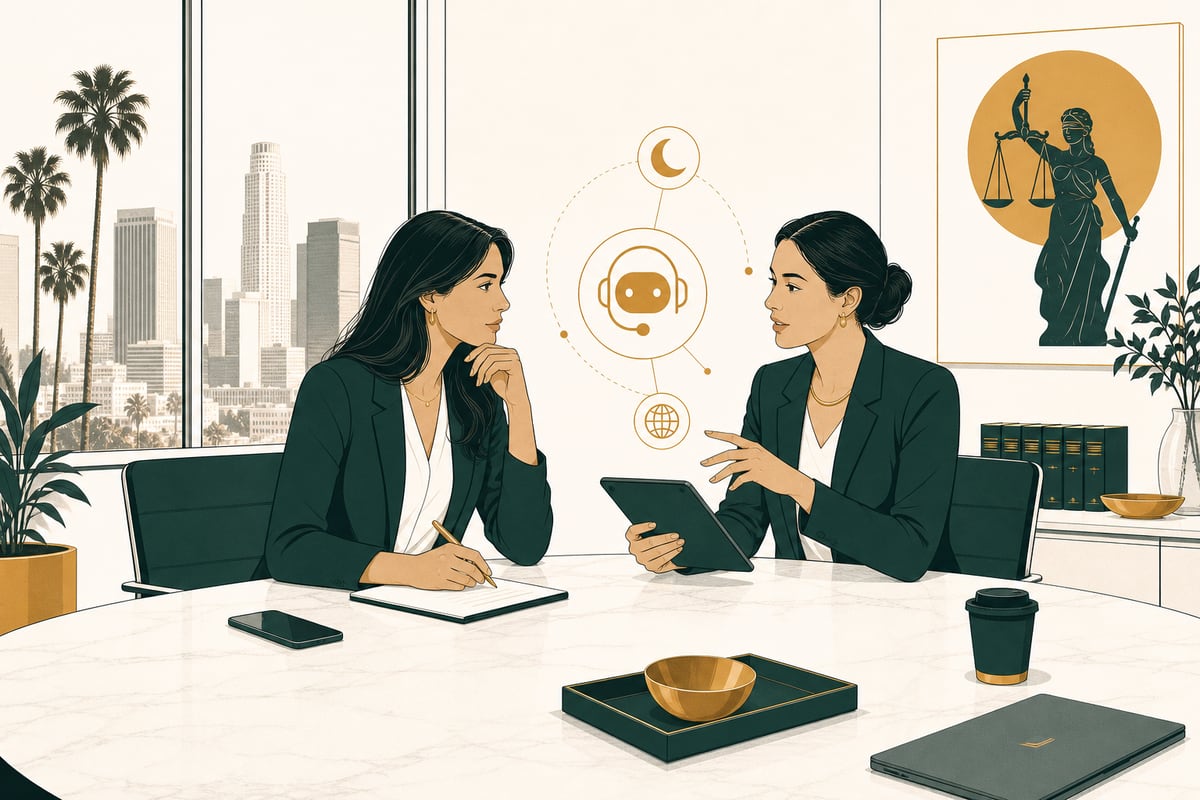
Most Los Angeles law firms should start AI on the phone after hours only, not as a full front-desk replacement. For immigration and personal-injury offices, that approach usually offers the best balance of bilingual coverage, client trust, and compliance while keeping human staff in control during business hours.
Why an after-hours-only policy makes sense
The biggest phone problem for many LA firms is not 10:00 a.m. coverage. It is nights, weekends, lunch breaks, court days, and the moments when a live team simply cannot pick up. That gap matters even more when callers are stressed, calling for the first time, and more comfortable in Spanish.
An after-hours-only AI policy is attractive because it solves a narrow, high-value problem:
- Answer the phone when the office is closed
- Offer English and Spanish from the first greeting
- Capture structured intake details
- Disclose recording when used in California
- Avoid giving legal advice
- Route urgent matters according to the firm’s rules
- Deliver a clean summary to staff for follow-up
That is a much tighter and safer job than asking AI to handle every call all day.
For immigration firms, after-hours callers may be dealing with deadlines, family stress, detention concerns, or fear about what to say. For PI firms, the caller may have just left the ER, may be in pain, or may be calling from a family member’s phone. In both cases, the first need is not a legal analysis. It is a calm, bilingual intake process that captures the basics and tells the caller what happens next.
What an after-hours AI receptionist should do
A law-office AI phone line works best when it is intake-only. It should not try to act like an attorney, interpret facts, predict outcomes, or answer legal questions.
A good after-hours setup should be limited to tasks like these:
- Greet the caller in English and Spanish
- State that the call may be recorded, when recording is enabled, to satisfy California two-party-consent disclosure requirements
- Identify whether the caller is a new or existing client
- Collect name, callback number, preferred language, and best time to reach them
- Capture matter type, basic facts, and timing
- Ask firm-approved screening questions
- Note urgency flags for the next business day
- Send the transcript or summary to the firm’s intake workflow
For PI, that may include date of incident, type of accident, whether medical treatment was received, and whether the caller already has a lawyer. For immigration, that may include matter category, deadlines, hearing dates, or whether the caller is seeking help for themselves or a family member.
The key is consistency. The AI should ask the same approved questions every time and stop where the firm tells it to stop.
What it should never do
This is where trust and compliance are won or lost.
An after-hours legal intake AI should never:
- Give legal advice
- Promise a result
- Estimate case value
- Tell a caller whether they “have a case”
- Instruct someone to miss a deadline or ignore a notice
- Present itself as a lawyer or paralegal
- Improvise answers beyond the firm’s approved script
For TelAI, this boundary is central. The system is intake-only. It gathers information and helps your office respond faster, but it does not replace legal judgment.
That limitation is not a weakness. It is the reason many firms are more comfortable trying AI after hours first.
The trust advantage of keeping humans on daytime calls
Some firms hesitate because they imagine an AI line taking over every client interaction. That is usually the wrong frame.
If your reception team is strong during business hours, there may be no reason to replace them. In fact, keeping live staff in place during the day can improve trust because:
- Existing clients still reach familiar humans during normal office hours
- Complex or emotional calls are handled by staff when the office is open
- Attorneys keep control over the tone of the client experience
- The AI is used only where voicemail would otherwise be the fallback
In other words, after-hours AI is often competing with missed calls and voicemail, not with your best staff member.
That is a very different business decision.
A practical policy LA firms can adopt
A useful phone policy should be simple enough for staff to understand and specific enough to audit. Here is a practical model for immigration and PI offices:
Business hours
- Calls ring to live staff first
- If the team is overloaded, the firm may choose voicemail, overflow handling, or a limited transfer path
- Attorneys and staff continue to handle legal questions and active-case communication
After hours
- The AI answers all new inbound calls
- The greeting immediately offers English and Spanish
- The system states that the call may be recorded, if recording is enabled
- The AI explains that it can collect intake information and arrange follow-up
- The AI does not provide legal advice
Urgent situations
- The firm defines what counts as urgent
- The AI follows a fixed script for urgent callers
- If the office wants, urgent messages can be flagged for immediate review by an on-call human
- If there is no emergency coverage, the script should say so clearly rather than implying live legal help is available
Next-business-day follow-up
- Intake staff review overnight calls first thing in the morning
- Spanish-speaking callers are assigned appropriately
- The office returns calls within a firm-defined time window
- Staff can see the summary and, where used, the transcript
This kind of policy reduces ambiguity. Everyone knows what the AI is for, what it is not for, and what the caller should expect.
Why this is especially effective for bilingual after-hours intake
Los Angeles firms serve a large population of Spanish-speaking clients, but many offices still handle after-hours language access inconsistently. A website may be bilingual, while the voicemail is not. A daytime receptionist may speak Spanish, while evening overflow does not. Or the office may rely on the caller to wait until the next day and try again.
That is risky.
For immigration and PI, the first call often comes when the person finally has privacy, transportation, or a family member available to help. If the office cannot respond in Spanish at that moment, trust can drop quickly.
A bilingual after-hours AI line helps by making the first interaction immediate and understandable. It does not solve every issue. It does not replace a lawyer or a trained bilingual intake specialist. But it can prevent a simple failure: making the caller feel unheard before your team ever gets a chance to call back.
Compliance and expectation-setting matter more than hype
The safest AI deployments are boring in the best way. They are scripted, disclosed, limited, and documented.
For California firms, recording disclosure is important because California is a two-party-consent state. If your system records calls, the caller should be told. Your office should also be clear internally about who can access call data, how long it is kept, and where summaries are sent.
Just as important, the AI should set expectations honestly:
- The office is currently closed
- The system can collect intake information
- A lawyer is not on the line
- No legal advice will be given on the call
- Someone from the office will follow up
These points sound simple, but they are exactly what protects trust.
Signs your firm is a good fit for after-hours-only AI
This approach tends to fit firms that:
- Already have a solid daytime receptionist or intake team
- Miss calls at night or on weekends
- Serve a meaningful number of Spanish-speaking callers
- Want a narrow, lower-risk starting point for AI
- Prefer to keep legal conversations with humans
- Need more consistent intake documentation
It may be less useful if your firm already has reliable 24/7 bilingual live coverage with strong intake quality. But for many small and mid-sized LA offices, that is not the reality.
The honest limitation
An after-hours AI receptionist is not a cure-all. If your intake process is weak, your callbacks are slow, or your staff does not follow up on captured leads, AI will not fix that by itself. It can capture more opportunities and organize them better, but the firm still has to close the loop.
That is why the best use case is operational, not magical: answer more calls, in both languages, with a controlled script, and hand clean information to humans who can take the next step.
Bottom line
If your LA immigration or PI firm wants to explore AI without risking the daytime client experience, after-hours-only is usually the smartest first policy. It gives you bilingual coverage when you are most likely to miss calls, keeps legal advice with humans, and creates a cleaner compliance boundary.
If you want to hear how a bilingual intake-only line sounds in practice, call the live demo at (213) 752-9794. If you are ready to set up a line for your office, visit /order.
Frequently asked questions
Can the AI answer legal questions from new callers?
No. TelAI is intake-only. It gathers information and sets expectations, but it does not give legal advice.
Should we use AI during business hours too?
Some firms do, but many should start after hours only. It is often the lowest-risk way to improve coverage without changing the daytime client experience.
Can the system handle Spanish-speaking callers naturally?
Yes. Bilingual English/Spanish intake is a core use case, especially for Los Angeles immigration and PI firms.
What about California call recording rules?
If calls are recorded, the system should disclose that clearly because California is a two-party-consent state.
How do we try it?
Call the live demo at (213) 752-9794 or go to /order to get started.